
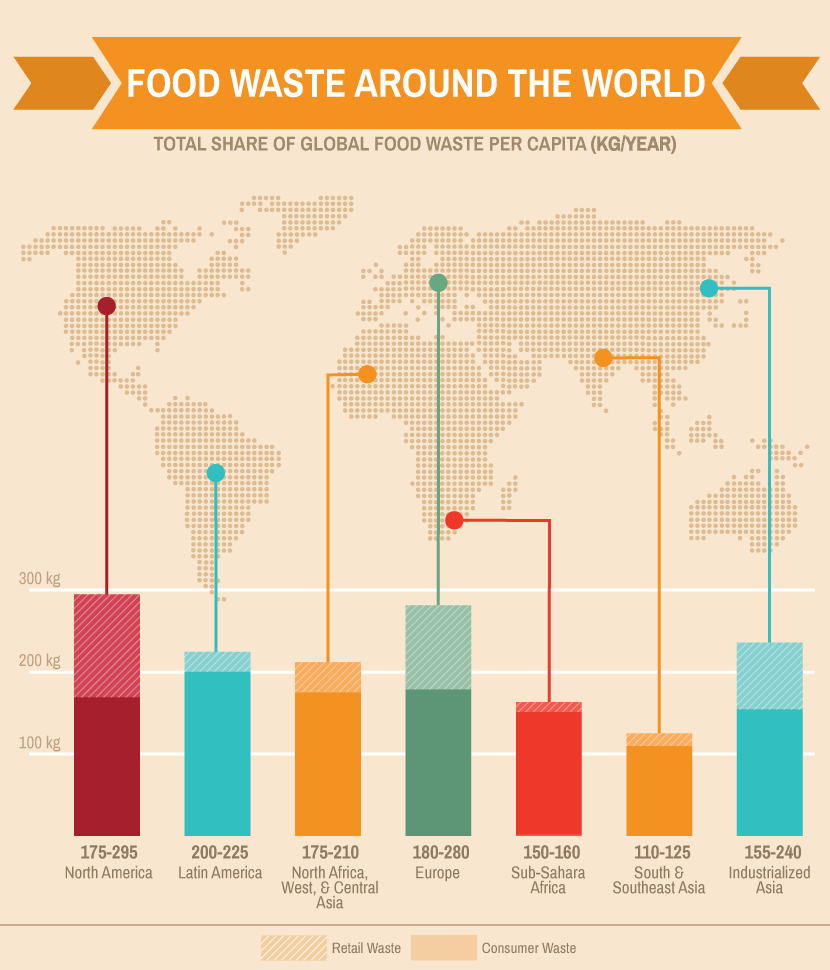
Food waste or food loss is food that is discarded or lost uneaten. Global food loss and waste amount to between one-third and one-half of all food produced. Loss and wastage occur at all stages of the food supply chain or value chain. In low-income countries, most loss occurs during production, while in developed countries much food – about 100 kilograms (220 lb) per person per year – is wasted at the consumption stage.
We might not think twice before throwing away spoiled milk, cheese coated in fuzz, or uneaten leftovers, but the impact of food wastage is enormous.
According to the USDA, in the United States, 31 percent of the food grown and raised, the equivalent of 133 billion pounds of food per year with a retail value in excess of $161 trillion, is never eaten. Almost one-third of all the bacon, tomatoes, apples, pasta, chicken, rice, and other foods purchased are tossed into the trash.
We might not think twice before throwing away spoiled milk, cheese coated in fuzz, or uneaten leftovers, but the impact of food wastage is enormous.
According to the USDA, in the United States, 31 percent of the food grown and raised, the equivalent of 133 billion pounds of food per year with a retail value in excess of $161 trillion, is never eaten. Almost one-third of all the bacon, tomatoes, apples, pasta, chicken, rice, and other foods purchased are tossed into the trash.
Food waste occurs at all stages of production, from farms and food processing facilities to supermarkets and restaurants. And, of course, it happens in our home.
Save the planet!

Food waste is not just an economic issue. Wasting food also takes its toll on the environment as food waste adds a huge strain on our natural resources. An enormous amount of water, energy, land and fuel go into making every bunch of bananas, or every loaf of bread that we eat. When we throw these food away, we are not only wasting our precious resources, but we are also creating toxic greenhouse gases in the process. The USDA notes that most wasted food is sent directly to the landfill where it is a major producer of methane, a potent greenhouse gas that contributes to climate change. So, when we choose to reduce the amount of food that we are wasting, consequently, we are choosing the planet.
How to save food?
1.Planning

The
best way to reduce food waste is to not create it in the first place and a bit
of planning
can help you do just that. Food planning – in whatever form works best
for you – it will save you time and money. It will help you make the
most of what you already have and buy the things you really need. Good
planning involves checking what you have already, planning your meals and
knowing what you need to buy. If planning every
meal of the week seems daunting, you can try planning 2-3 days ahead or just
weeknight dinners.
2.Shopping

Smart shopping can stop you throwing away huge of money a year in
wasted food. There are a few basic principles to remember:
- Know
what you need to buy before you go.
- Writing
a shopping list is essential but so is checking the fridge and cupboards
first so you know what you have.
Planning your meals around food that is in season is usually
cheaper and it’s often fresher so will last a lot longer.
If sticking to your list in-store can be difficult, you can try
avoiding shopping when hungry or with children.
And remember a bulk-buy deal or 2-for-1 special is only good value
if you use it. It’s not a bargain if it ends up in the bin.
3.Cooking

Waste-free cooking can be easy and make cooking more fun and less stress. The best things you can do to cook without waste are:
- To cook to a meal plan.
- Get creative to use up ingredients.
- Cook the right amount to avoid leftovers.
A meal plan can save you
both time and stress and will help you use up what you’ve bought.
Cooking the right amounts can also help you waste less. If you don’t want
leftovers, it makes sense to be more cautious with your portion sizes. But if
you love your leftovers, deliberately making larger portions to freeze or eat
for lunch can save you heaps of food, money and time.
4.Food safety

It’s
important to remember a few basic food safety rules to ensure you stay healthy
and reduce your food waste:
- Wash your hands before and whilst preparing food.
- Keep foods out of the temperature 'danger zone'. Between 5 and 60 degrees Celsius is where bacteria, a common cause of food poisoning, can reproduce quickly. Put food in the fridge within 2 hours.
- Prevent cross-contamination. Always keep raw meats separate from ready-to-eat food.
- Make sure all food (particularly seafood, poultry and meat) is cooked thoroughly.
5.Storage

Storing food correctly can make it last weeks, or even months or longer. For example:
- Dry goods can be stored for up to six months. Once a package is open, it’s best to move it to an air-tight container.
- Store your nuts in air-tight containers if possible—these allow them to maintain the right level of moisture. For ultimate freshness, consider storing them with their shells on.This will ensure freshness and keep your pantry cleaner.
- Heat, light, air, and humidity are all spices’ enemies; your spices should live in your pantry. Whole spices last much longer than crushed or ground—these can be kept for up to two years, while ground spices should be refreshed every six months. Airtight tins or small spice jars are the best mode of storage.
- Store raw meat and poultry in clean, sealed containers on the bottom shelf of the fridge.
- Follow any storage instructions on the label and don't eat meat after its use by date.
- Keep cooked meat separate from raw meat and ready-to-eat foods in general.
- For safety and to reduce waste, only take out of the freezer what you intend to use within the next 24 hours.
6.Compost
 Composting food scraps does not cut down on food waste, but it does keep banana peels, apple cores, and other inedible foods from going to the landfill and adding to greenhouse gas emissions. Compost is also a nutrient-rich soil amendment that can help your vegetable garden thrive!
By knowing your impact, and following these smart steps above, you can do your part in the shift towards greater efficiency in our food systems.

By knowing your impact, and following these smart steps above, you can do your part in the shift towards greater efficiency in our food systems.

Really interesting n informative dear❤️❤️
ReplyDeleteThank you ❤
ReplyDeleteA very thought-provoking and informative article. It is really helpful dear
ReplyDeleteThank you for posting this����
Thank you dear <3
DeleteVery informative and useful tips indeed
ReplyDeleteThoughtful and thank you for the innovative ideas
ReplyDeleteThank you Shivanee ❤️
DeleteGreat article, very informative and everything is properly laid out in a simple and concise manner.
ReplyDeleteThank you Rohan ❤️
DeleteVery enriching knowledge. Thanks for sharing ����
ReplyDeleteThank you Yashna ❤️
DeleteVery informative and helful article...
ReplyDeleteHelp us reduce food waste and opt for a sustainable living.��Thank you for these interesting ideas.��
Thank you Gopika ❤️
DeleteFood wastages have been escalating since the begining. It shows no end. Thanks to your precious article, I can now diminish food wastages at home. I shall also recommend my circle to adapt the teachings of this article. Thank you for the enlightment. I shall look forward for more articles of yours.
ReplyDeleteThank you Huddiya ❤️
DeleteVery constructive and informative..thanks for helping us to be more conscious about the reality of this era...
ReplyDeleteThank you ❤️
DeleteThanks for this article very helpful for me who is on going to zero food waste.
ReplyDelete